

Section 179 Tax

THE 2026 SECTION 179 TAX DEDUCTION RESOURCE
Your trusted resource on Section 179 tax deductions since 2006. Section179.Org is a completely free resource - offering expert answers, interactive tools, and comprehensive guidance to help you maximize your Section 179 tax benefits at no cost to you.
WHAT IS SECTION 179?
The 2026 Section 179 tax deduction can let eligible businesses immediately write off up to $2,560,000 of qualifying equipment placed in service during the year-rather than depreciating it over many years. The deduction begins to phase out when total qualifying purchases exceed $4,090,000. This powerful business tax incentive can apply to both new and used equipment, certain business vehicles, and off‑the‑shelf software.
2026 SECTION 179 DEDUCTIONS: QUICK REFERENCE
Transform your business purchases into immediate tax savings with Section 179. This comprehensive guide explains how to maximize the 2026 deduction limits and preserve your company's cash flow.
- Max Deduction (2026): $2,560,000 (phased out above $4,090,000)
- Bonus Depreciation (2026): May also be available after Section 179 is applied (rules/percentage depend on current law and property type)
- New & Used Equipment: Qualifies for full Section 179 deduction
- Specialized (Non‐Passenger) Vehicles: Qualifies for full Section 179 deduction
- SUVs & Trucks >6,000 lbs GVWR: $32,000 max first‐year Section 179 for certain SUVs; remainder depreciated
- Business‐Use Requirement: >50% business use; deduction limited to % of business use
- Timing: Equipment must be purchased, installed, and placed in service by December 31, 2026
- Installation & Documentation: Ensure proper installation and maintain documentation to support your deduction claim
Note: The Section 179 deduction phases out dollar‑for‑dollar when total qualifying purchases exceed $4,090,000 and is fully phased out at $6,650,000.
Pro Tip: Plan ahead for delivery and installation lead times to meet year‑end requirements. General information only; confirm eligibility, timing, and any business-income limits with your tax professional.
EXAMPLE CALCULATION
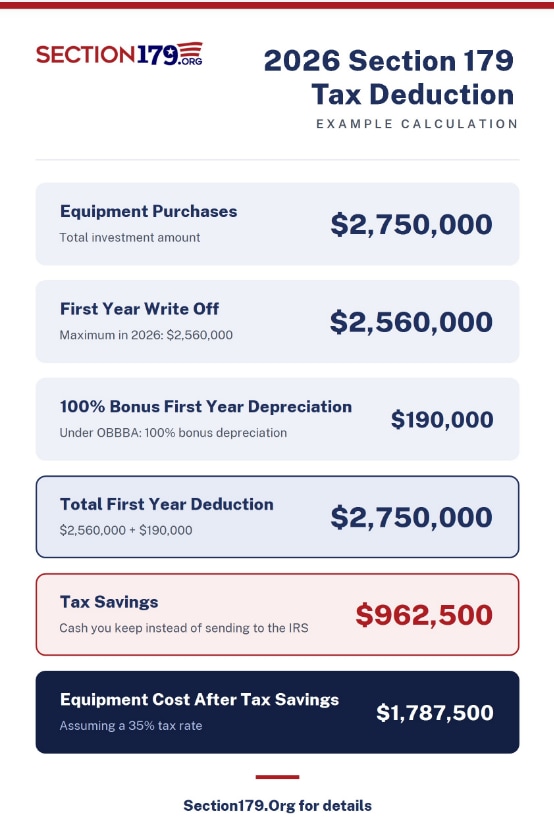
Equipment Cost: $75,000
Potential Section 179 Deduction: $75,000 (subject to the overall $2,560,000 cap, phase‑out rules, and eligibility)
Estimated Tax Savings: $26,250 (assuming ~35% effective tax rate)
Effective Net Cost: $48,750
This example illustrates how a first-year write-off can reduce the after-tax cost of equipment and help preserve cash flow for other business priorities.
SECTION 179 QUALIFYING PROPERTY: KEY REQUIREMENTS
To qualify, the property generally must be:
New to you: New or used is OK, but it must be newly acquired by your business.
Used more than 50%: Must be used more than 50% for business operations.
Placed in service: Ready and available for its specific use during the tax year.
Financing: Financed purchases can qualify-Section 179 is not limited to cash purchases.
WHAT "SECTION 179 QUALIFIED FINANCING" MEANS
Definition: "Section 179 Qualified Financing" is an industry term for equipment financing structured so your business is treated as the purchaser (the tax owner) of the equipment-meaning you may be able to claim a Section 179 deduction in the year the asset is placed in service, even though you repay the lender over time.
When you finance your equipment purchase, you can still take full advantage of the Section 179 deduction as long as the asset is placed in service during the tax year.
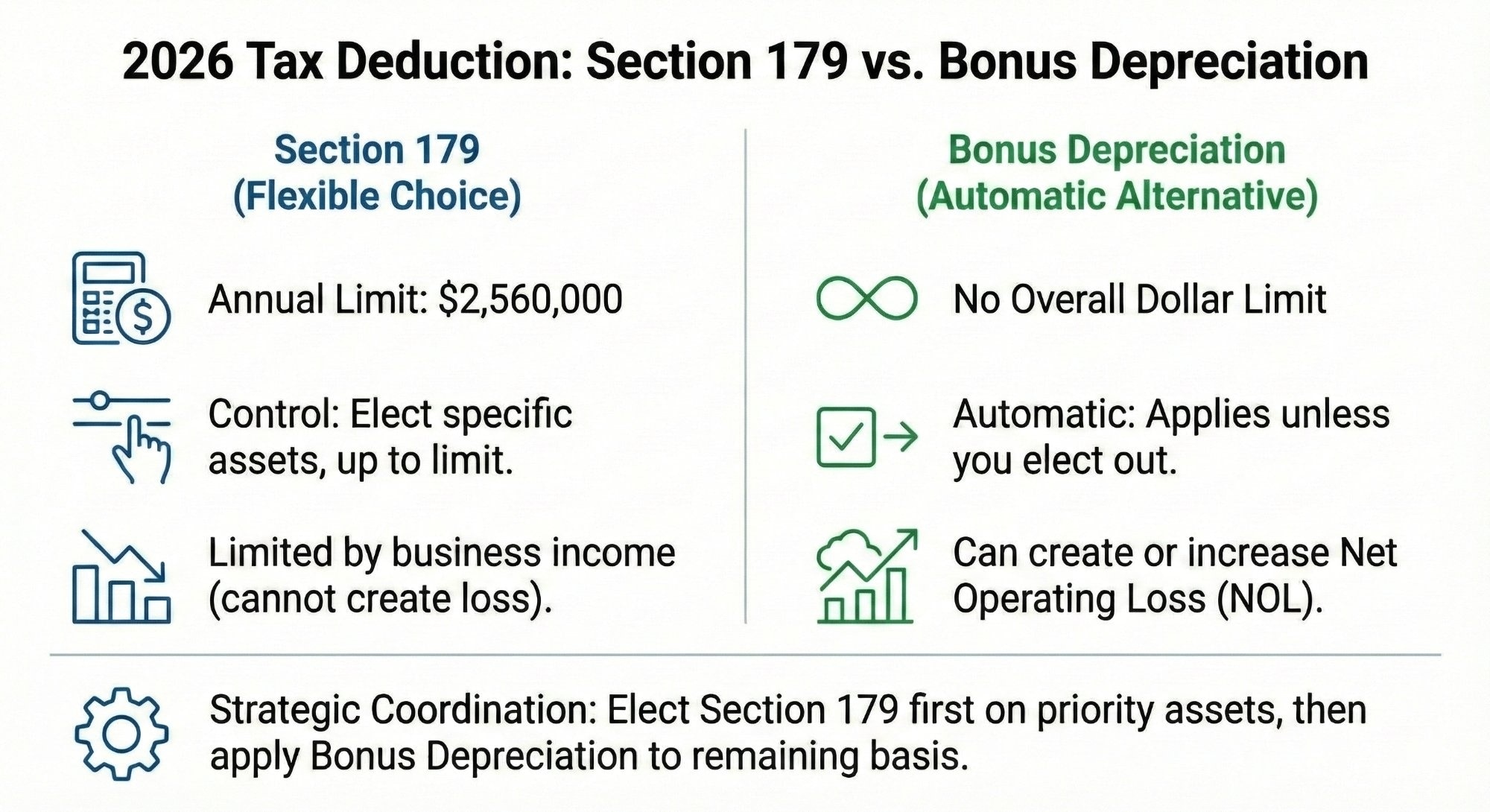
SECTION 179 VS BONUS DEPRECIATION: KEY DIFFERENCES FOR 2026
Business owners and tax professionals know that choosing the right way to recover equipment and software costs can affect taxable income and cash flow.
Definitions:
Section 179 deduction: An election to expense some or all of the cost of qualifying business property in the year it's placed in service (subject to annual dollar limits and a taxable income limitation).
Bonus depreciation: An additional first‑year depreciation deduction under Section 168(k) that generally applies automatically to eligible property unless you elect out.
This guide explains how to choose-and how businesses often coordinate both tools: elect Section 179 first on priority assets, then apply bonus depreciation to any remaining eligible basis.
FREQUENTLY ASKED QUESTIONS (FAQS)
What is the Section 179 Deduction?
Section 179 is a federal tax provision that lets businesses deduct the full purchase price of qualifying equipment and software in the year it's placed in service, rather than depreciating it over several years. The deduction is subject to annual dollar limits, a phase-out threshold, and a taxable income limitation. Listed property (such as vehicles) must generally be used more than 50% for business to qualify. For full eligibility details, see our Qualifying Property page.
What Are The Section 179 Limits for 2026?
The 2026 Section 179 deduction limit is $2,560,000 (for tax years beginning in 2026). The deduction begins to phase out when the total cost of qualifying property placed in service exceeds $4,090,000; each dollar over that threshold reduces the available deduction dollar-for-dollar (fully phased out at $6,650,000). These limits are adjusted annually for inflation.
What types of assets qualify for the Section 179 deduction?
Assets that may qualify include new and used equipment, business vehicles (over 6,000 lbs GVWR), off‑the‑shelf software, and select improvements - when used more than 50% for business and placed in service during the tax year.
Can I claim the Section 179 deduction for used equipment?
Yes - Section 179 applies to both new and used equipment, provided it's new to your business and meets all IRS eligibility requirements.
What Vehicles Qualify for Section 179?
Many business vehicles can qualify for Section 179 if used more than 50% for business, though deduction limits vary by vehicle weight and type. Work vehicles and vans designed for non-personal use may qualify for the full Section 179 deduction. SUVs rated between 6,001 and 14,000 lbs GVWR have a separate Section 179 cap of $32,000 for 2026, prorated by business use. Passenger cars and light trucks (6,000 lbs GVWR or less) are subject to annual "luxury auto" depreciation limits, also prorated by business use.
Can I still claim the Section 179 deduction if I finance my equipment?
Yes. Financing does not prevent the deduction - financed equipment can qualify for the full Section 179 deduction as long as it's placed in service by the deadline and otherwise meets the requirements.
When Is the Section 179 Deadline?
For most calendar-year businesses, the Section 179 deadline is December 31, 2026: the property must be placed in service - ready and available for use in your business - by the end of your tax year. Ordering or paying for equipment is not enough; it must be operational by the deadline. The Section 179 election is then made on your timely filed return (including extensions) for that tax year. Missing the placed-in-service deadline generally defers the deduction to the following year.
How Can We Help?
* Indicates a required field
Price excludes tax, title, license fee, government fees, and $449 dealer documentary service fee. While every reasonable effort is made to ensure accuracy, we are not responsible for errors or omissions. Vehicles may be sold prior to inquiry. Please contact dealer to confirm availability. Vehicles listed as “Not in Stock” may be available within a reasonable timeframe, not to exceed one week. All financing is subject to approved credit.
-
Salt Lake Valley Chevrolet
4050 West 3500 South
West valley City, UT 84120
- Sales: (801) 969-8221
Loading Map...